pr_runtime
Turn merged pull requests that ship tests into SWE-bench-style tasks graded by the tests the fix makes pass.
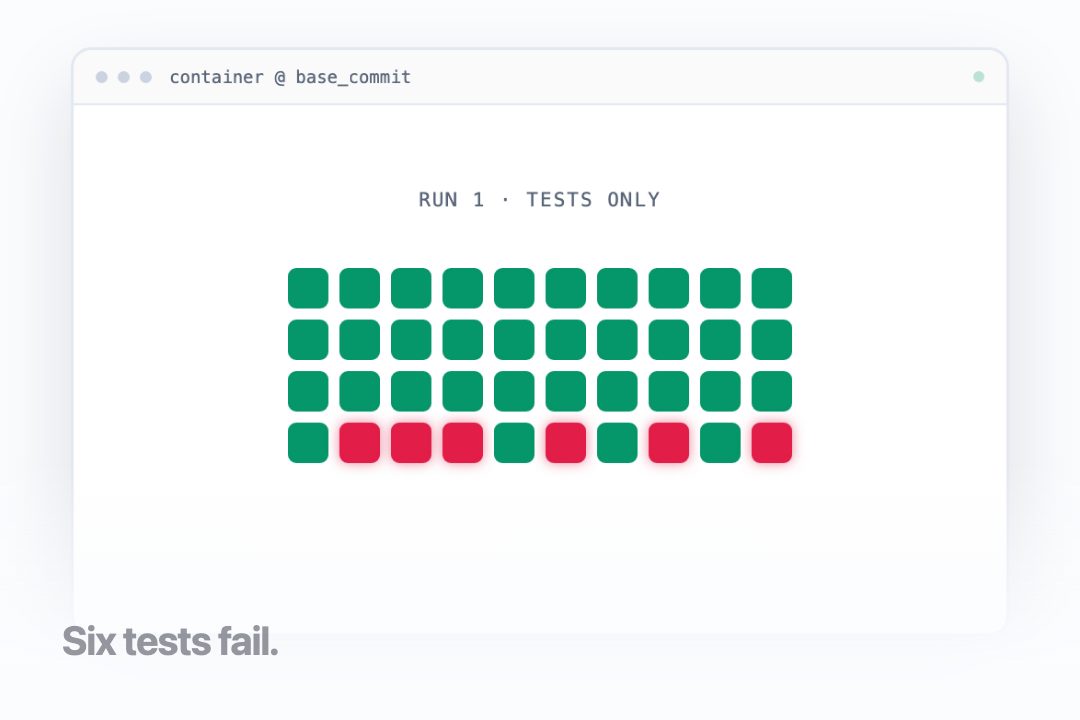
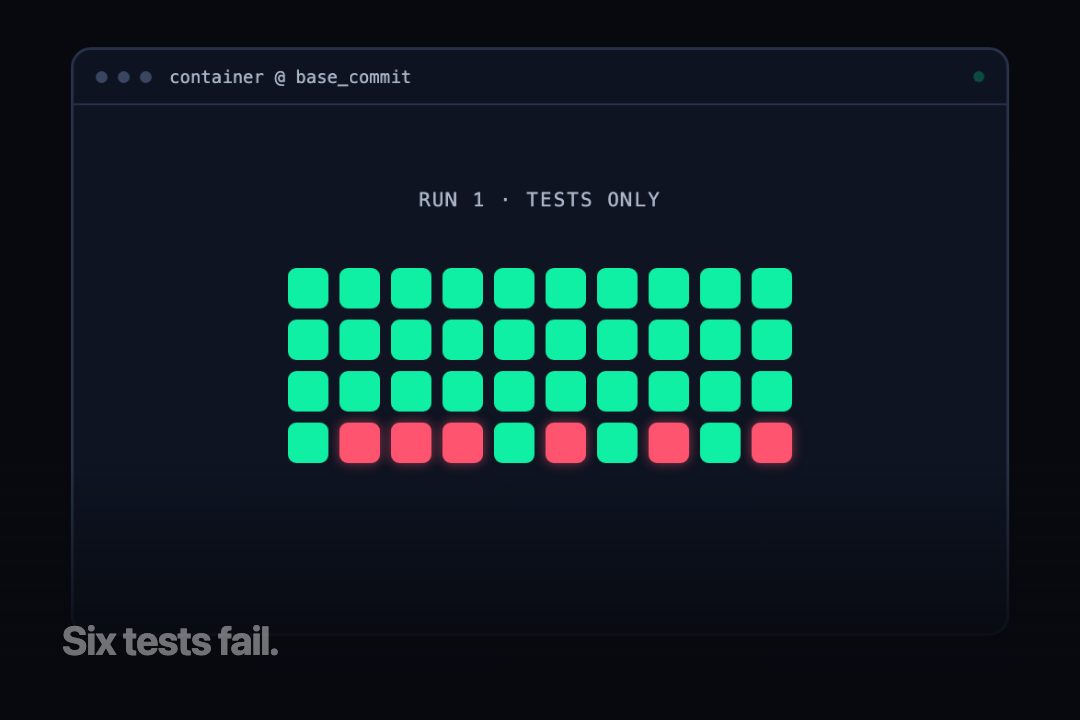
Each task is a merged pull request that fixed a bug and added a test for it. The agent gets the linked issue and changes the source; the PR's own tests, hidden until verification, decide the reward. The pipeline runs every candidate's tests twice in a Docker image built for the repository and keeps a PR only if some tests fail before the fix and pass after it.
At a glance
| Input | A GitHub or GitLab repository with merged PRs that add tests |
| Task | Resolve the issue a merged PR fixed, starting from its base commit |
| Reward | Graded f2p_rate × p2p_rate, plus strict resolved and command_resolved flags |
| Needs an LLM | Yes, for the one-time repository bootstrap (cached) |
| Needs Docker | Yes, for bootstrap, validation and running tasks |
| Hosts | GitHub (needs gh on PATH) and GitLab |
| Languages | Any repository the bootstrap can build whose tests run under pytest, unittest, Django, go test, cargo test, cargo nextest run, Jest, Mocha or Vitest. The reference dataset has 63 Python and 37 Go tasks |
| Status | Stable |
| Reference dataset | FineEnvs/repo2rlenv-pr-runtime: 100 tasks from 13 repositories |
Two test sets define each task (F2P and P2P). FAIL_TO_PASS (F2P) tests fail or error at the base commit and pass once the fix is applied: they prove the bug existed. PASS_TO_PASS (P2P) tests pass both before and after: they guard against regressions.
Quickstart
repo2rlenv generate \
  --repo pallets/click \
  --pipeline pr_runtime \
  --pipeline-opt limit=20 \
  --pipeline-opt require_linked_issue=true \
  --llm anthropic/claude-sonnet-4-6 \
  --out ./tasks/click-pr-runtime
The first run bootstraps the repository: an LLM agent builds a Docker image in
which the test suite runs, capped by --max-spend-usd (default 5.0). The image is
cached, so later runs go straight to mining. limit counts PRs listed, not tasks
emitted; PRs without a test that flips from failing to passing are skipped, so
expect fewer tasks than limit. Each task lands in
./tasks/click-pr-runtime/pallets__click-<pr>/. Run the oracle, which should
score 1.0:
harbor run -p ./tasks/click-pr-runtime -a oracle --env dockerEach task's Dockerfile starts FROM the local bootstrap image, so tasks run on
the machine that generated them until you publish them with repo2rlenv push,
which pushes or inlines the image.
How it works
- Bootstrap the repository once. An LLM agent iterates in Docker until the test suite runs, and records the image and test commands. Results are cached. See Bootstrap.
- List merged PRs, newest first, exactly as
pr_diffdoes. - Filter on metadata. Skip drafts, unmerged PRs, PRs with no files, and titles
that mark chores rather than fixes: backports, cherry-picks, reverts, version
bumps, releases, changelogs and branch merges or syncs. Optionally require a
minimum description length (
min_problem_statement_words). - Split the diff into a source patch and a test patch by file path. Skip the PR if either is empty.
- Filter on structure. Skip PRs whose source changes are all under
.github/(skip_ci_only), whose test patch adds no test function or class (require_new_test_funcs), or that touch more thanmax_source_files_per_prsource files.lite_filteradds SWE-bench Lite-style constraints. - Validate twice in one container started from the bootstrap image. Reset to
the base commit, apply the test patch and run the tests that patch touches; then
reset, apply the fix and the test patch, and run them again. Keep the PR if at
least
min_fail_to_passtests move from failed or errored to passed. - Write the instruction from the linked issue (
Fixes #123, including the[#123](url)form) when there is one, otherwise from the PR title and description. Solution pointers and template sections are stripped. - Emit the task with the fix as the oracle and the test patch hidden inside
tests/test.sh.
Options
Pass each option with --pipeline-opt key=value.
| Key | Default | What it does |
|---|---|---|
limit | 50 | Maximum merged PRs to list. You get at most this many tasks |
since / until | none | ISO dates (2026-01-31) bounding the merge date |
skip_drafts | true | Skip draft PRs |
require_fail_to_pass | true | Skip PRs with fewer than min_fail_to_pass F2P tests after validation |
min_fail_to_pass | 1 | Minimum number of F2P tests |
validation_timeout_sec | 600 | Timeout for each of the two validation test runs |
skip_validation | false | Emit candidates without running tests. Tasks then have no F2P/P2P lists and a pass/fail exit-code reward. For debugging |
require_new_test_funcs | true | Require the test patch to add at least one test function or class |
skip_ci_only | true | Skip PRs whose source changes are all under .github/ |
max_source_files_per_pr | 50 | Skip PRs that touch more source files than this |
min_problem_statement_words | 0 | Minimum word count of the PR description. 0 disables the check |
lite_filter | false | SWE-bench Lite-style sampling: exactly one source file, a description of at least 40 words, and no images, non-GitHub links or commit hashes in it |
state | merged | Only merged is accepted |
require_linked_issue | false | When true, skip PRs whose description does not contain a linked issue reference (e.g. Closes #123) |
languages | ["python"] | Accepted but not enforced: the language comes from the bootstrap |
Output
task.toml: Harbor 1.0 task with[metadata.repo2env.pr_runtime](PR URL, merge time, base commit, F2P and P2P lists,validation_status, bootstrap image digest),reward_calibration(f2p_count,p2p_count,source_files,loc_changed,difficulty) and an evaluation label that starts asunverified.instruction.md: the issue (or PR) title and description with solution pointers removed.environment/Dockerfile:FROMthe bootstrap image, reset to the base commit, with git history past it removed.environment/docker-compose.yaml: an egress guard that points PyPI and GitHub hosts (plusgitlab.comfor GitLab sources) at0.0.0.0, so the agent can't download the fixed release or the merged PR. See contamination defenses.solution/patch.diff: the PR's source changes only (the oracle);solve.shapplies it.tests/test.sh: resets the PR's test files to the base commit, applies the hidden test patch, runs the targeted test commands and calls the verifier.tests/verifier.py: the standalone graded verifier (Python standard library only).tests/f2p.json,tests/p2p.json: the F2P and P2P test names.
Reward
Python unittest and Django use their verbose TextTestRunner output. The pipeline
adds -v for unittest and verbosity 2 for Django, and groups subtests under their
parent test with the worst status winning. Both generation and the exported
verifier use the same test identities.
The verifier parses the test log into a status per test and scores:
f2p_rate = F2P tests now passing / F2P tests
p2p_rate = P2P tests still passing / P2P tests   (1.0 when there are none)
reward   = f2p_rate × p2p_rate                    → /logs/verifier/reward.txt
The graded reward is the training signal: fixing four of five failing tests
earns 0.8 instead of 0. Two booleans in /logs/verifier/reward-details.json are
the evaluation signals:
resolved: every F2P and P2P test passes. This is SWE-bench resolution; the oracle satisfies it on every task.command_resolved:resolved, no failing test outside the F2P and P2P sets, and a test command that exits 0. Tasks whose test command also runs unrelated failing or flaky tests stay usable for training but miss this flag.
The details file also records per-set totals and rates, regressions,
untracked_failed_count, the first 20 untracked_failed names, runner,
tests_parsed, exit_code and parse_status. The published manifest adds
eval_grade (command_resolved and a non-empty P2P set); filter on it for a
benchmark-grade subset.
The agent can't pass by editing tests: test.sh restores the PR's test files and
re-applies the hidden test patch before running them. If the patch doesn't apply,
the task fails closed with reward 0 and parse_status set to
test_patch_apply_failed. If the log can't be parsed, the verifier falls back to
1.0 for a zero exit code and 0.0 otherwise, marks parse_status as
fallback_exitcode, and never reports resolved for a task with an F2P list.
task.toml also lists diff_similarity as a secondary reward kind. Trainers that
can't run code can score a patch against solution/patch.diff with
repo2rlenv.reward.calculate_diff_similarity_reward. See
Rewards.
Yield and cost
No generation denominator or cost ledger was recovered for the reference dataset, so yield is unmeasured. What drives it:
- Test signal. A PR must add a test function whose test fails before the fix and passes after it. Many merged PRs ship no test, or only change existing ones.
- Repository health. The suite must run inside the bootstrap container. Suites that need network access, GPUs or external services yield little whatever the options.
- Filters.
lite_filter,min_problem_statement_wordsandmax_source_files_per_prtrade count for focus.
Cost is one bootstrap per repository (LLM calls, capped and cached) and then two test runs per candidate; mining itself makes no model calls. The run summary counts each skip reason.
For the reference dataset, the gold patch scores 1.0 with every tracked test
passing on all 100 tasks; 88 are also command_resolved and 87 are eval_grade.
The release report describes roughly 55–60% solved in a Claude Sonnet pilot of
about 20 tasks, but the raw sample wasn't recovered. See
native results.
Limits
- A generated task isn't a verified environment. Run the controls: the oracle
should score 1.0 and a no-op agent (
-a nop) 0. Record the outcome as an evaluation label; see Quality. - Python means pytest. Logs from
unittestand Django's test runner produce no oracle (#167), and neither doescargo nextest(#172). - The egress guard is a denylist. It blocks PyPI and the code host; general internet stays up so hosted agents can run. The Go module proxy and crates.io still serve fixed releases (#160). For trustworthy evaluation numbers, run without network access.
- Instructions without an issue come from the fixer. When a PR links no issue, the PR description is used, and it can describe the fix in prose.
- One validation run per stage. Flaky tests can land in the F2P or P2P sets,
and
pr_runtimedoesn't cap the P2P set. - Tasks depend on a local image until you publish them with
repo2rlenv push. - GitLab listing sees at most the newest 100 merged MRs.
Related
- RFC 0002: pr_runtime
- Reference dataset and its validation evidence
commit_runtime: the same verifier on commits instead of PRspr_diff: the same PRs, scored by diff similarity without running tests- Bootstrap, Tasks, Rewards and Run with Harbor
- Adapted from the SWE-bench and SWE-bench-Live collection and grading approach. No code is copied, and the
swebenchpackage isn't a dependency.
Implementation notes
Source: pipelines/pr_runtime.py,
pipelines/pr_runtime_validate.py,
pipelines/_pr_runtime_verifier.py
and log_parsers/.
Test file classification
A file is a test file if any directory in its path is test, tests, testing,
e2e or __tests__, or if its name matches test_*.py/.js/.ts, *_test.py,
*_test.go, *.test.ts/.js or *.spec.ts/.js. Files under docs/, doc/,
documentation/, examples/ or example/ never count, so src/click/testing.py
and docs/testing.md stay in the source patch. A rename counts as a test if either
path does.
Test commands
The bootstrap records fast, tolerant commands; before each run the pipeline adapts them so they emit per-test lines, then targets them at the PR's test files:
| Runner | Adjustment | Targeting |
|---|---|---|
| pytest | Drop --collect-only, --co, -q; add -v | Append the changed .py test files |
go test | Add -v | Replace ./... with the changed test packages |
cargo test | Drop -q | Whole suite (Rust filters by name, not file) |
| Jest, Mocha | Drop --silent; add --verbose | Append the changed JS/TS test files |
| Vitest | Use --reporter=verbose | Append the changed JS/TS test files |
Trailing | head/| tail, 2>&1 and > /dev/null are stripped first. The runner
is detected from the command; the bootstrap's language is the fallback. test.sh
prepends the usual Go, Rust, Node and Java toolchain directories to PATH, because
bootstrap agents don't always persist them.
Validation and emission details
- Validation reuses one container for all candidates and fetches each base commit on demand, since the bootstrap image holds a shallow clone.
git cleankeeps dependency and build directories (node_modules,target,vendor,.venv,.tox,.gradle, …), so a reset doesn't break the suite.- Test output is fenced by
R2E_START_TEST_OUTPUTandR2E_END_TEST_OUTPUTmarkers on stdout, with stderr folded in, because unittest and Jest report there. - F2P includes tests that error at the base commit, such as a new test importing a symbol the fix introduces.
- For Go, a failing subtest whose parent test also failed isn't counted again as an untracked failure.
- The task Dockerfile installs
git, CA certificates andpython3when the bootstrap image lacks them, since the verifier is Python. - The instruction builder drops HTML comments and everything from the first checklist, changelog, test-plan or "tests added" heading, which would otherwise name the grading tests. The body is capped at 4,000 characters.