code_instruct
Have an LLM write coding tasks anchored in a repository's own code, and keep only those its test and solution prove out.
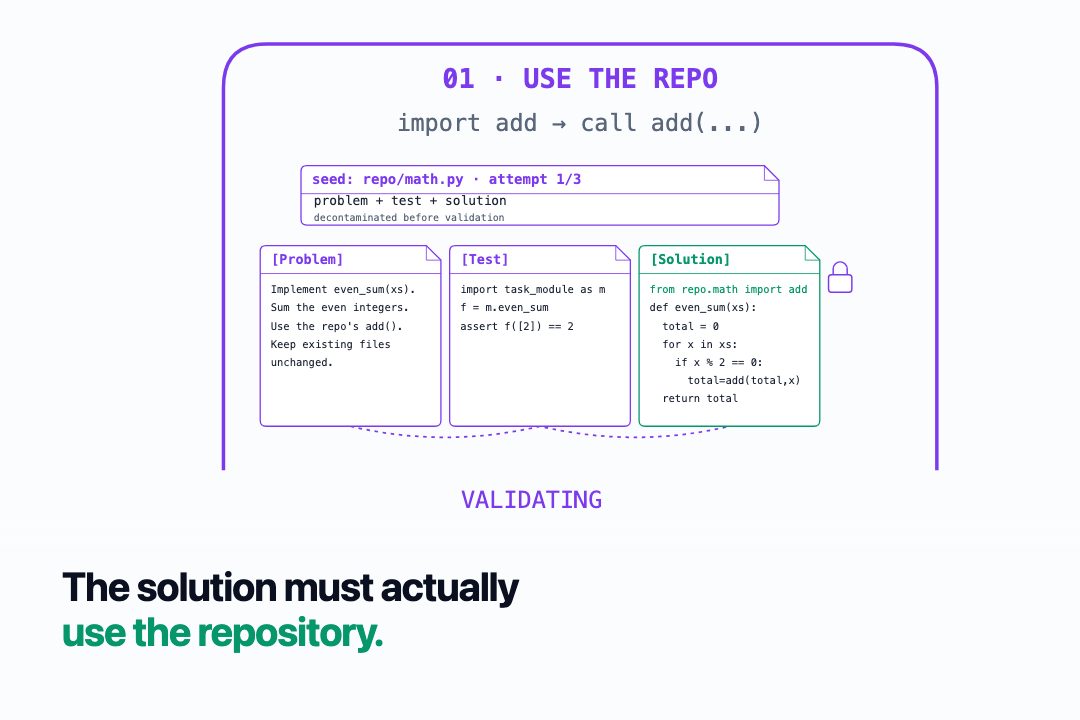
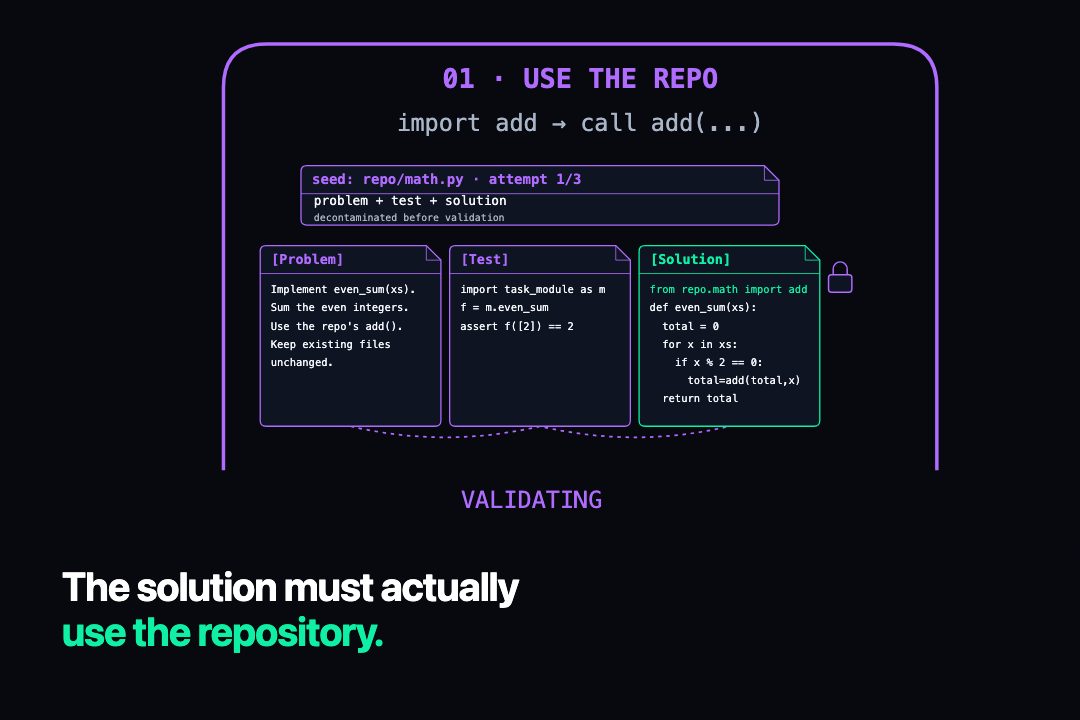
Each task asks the agent to write a new module, task_module.py, that builds on
the target library's API. An LLM invents the problem, a pytest test and a reference
solution from a random snippet of the repository in one call. The pipeline keeps
the task only if the test fails without the solution and passes with it inside the
repository's Docker image; the hidden test is the reward.
At a glance
| Input | A Python repository on GitHub, GitLab or a local path |
| Task | Implement task_module.py so a hidden pytest test passes, using the repository's package |
| Reward | Binary: 1.0 if the hidden test file passes, else 0.0 |
| Needs an LLM | Yes: the one-time bootstrap (cached) and one call per synthesis attempt |
| Needs Docker | Yes, for bootstrap, validation and running tasks |
| Hosts | GitHub, GitLab and local paths |
| Languages | Python only. On GitHub, the repository's primary language is checked first (--force-language skips the check) |
| Status | Experimental |
| Reference dataset | FineEnvs/repo2rlenv-code-instruct: 100 tasks, 20 each from click, flask, requests, attrs and starlette |
Quickstart
repo2rlenv generate \
  --repo pallets/click \
  --pipeline code_instruct \
  --pipeline-opt limit=5 \
  --pipeline-opt seed=42 \
  --llm anthropic/claude-sonnet-4-6 \
  --out ./tasks/click-code-instruct
Here limit is the number of tasks to emit; the pipeline samples up to five
snippets per requested task before it gives up. seed makes snippet sampling
repeatable. The first run bootstraps the repository (capped by --max-spend-usd,
default 5.0, and cached). Each task lands in
./tasks/click-code-instruct/pallets__click-cinst-<hash>/. Run the oracle, which
should score 1.0:
harbor run -p ./tasks/click-code-instruct -a oracle --env dockerHow it works
- Bootstrap the repository once and shallow-clone it at
--ref. See Bootstrap. - Find the package. Read
[project].namefrompyproject.toml, or look forsrc/<repo>/__init__.pyor<repo>/__init__.py, and list the package's top-level symbols. - Sample a seed. Pick a random file matching
file_globand notexclude_glob, then a random window ofseed_min_loctoseed_max_loclines. Windows that are at least 80% blank lines, comments or imports are resampled. - Synthesize. One call asks for three sections,
[Problem Description],[Test]and[Solution]. The prompt requires the problem to build on the package's public API, the test to import fromtask_modulewith 3–6 assertions including apytest.raises, and the solution to import and use the package. - Gate the candidate. Reject it if it matches a known benchmark phrase, if the
test doesn't import
task_module, if the solution doesn't import and use the package, if a top-level name in the solution already exists in the package, if the test is weak, or if it duplicates an earlier task. A rejected candidate is retried on the same seed up tomax_attempts_per_seedtimes. - Verify in the sandbox. With only the test file in place, pytest must not
pass. With the solution written to
task_module.py, it must pass. - Emit the task. The instruction is the generated problem plus a delivery
contract: write the implementation to
/workspace/task_module.py, don't modify existing files, and expose the names the problem mentions.
Options
Pass each option with --pipeline-opt key=value.
| Key | Default | What it does |
|---|---|---|
limit | 50 | Number of tasks to emit. At most five times this many seeds are sampled |
seed_min_loc / seed_max_loc | 30 / 200 | Snippet window size, in lines |
file_glob | **/*.py | Files to sample seeds from |
exclude_glob | tests, test_*, *_test.py, docs/, examples/, __init__.py | Files never used as seeds |
seed | none | Random seed for snippet sampling |
max_attempts_per_seed | 3 | LLM attempts per seed when a gate rejects the candidate |
llm_temperature | 0.7 | Sampling temperature for synthesis |
max_llm_tokens | 2048 | Output token limit for synthesis |
require_test_fails_without_oracle | true | Reject tests that pass without task_module.py |
require_test_passes_with_oracle | true | Reject tasks whose solution fails its own test |
validation_timeout_sec | 180 | Timeout for each sandbox test run |
skip_validation | false | Emit without running the sandbox checks. For debugging |
skip_decontamination | false | Skip the benchmark-phrase check |
Output
task.toml: Harbor 1.0 task.referencelinks to the seed lines;[metadata.repo2env.code_instruct]records the seed path and line range, the test file name, the bootstrap image andllm_cost_usd. The evaluation label starts asunverified.instruction.md: the generated problem statement and the delivery contract.environment/Dockerfile:FROMthe bootstrap image, with the repository as bootstrapped.solution/patch.diff: createstask_module.py(the oracle);solve.shapplies it.tests/test_r2e_<hash>.py: the generated test. Harbor deliverstests/at verify time for every agent.tests/test.sh: copies the test into/workspaceand runspython -m pyteston it.
Reward
tests/test.sh writes 1.0 to /logs/verifier/reward.txt when the test file passes
and 0.0 otherwise. There is no partial credit and no reward-details.json. A no-op
agent scores 0, because the test can't import task_module. See
Rewards.
Yield and cost
The reference generation log records 136 sampled seeds for 100 exported tasks, a 73.5% yield. Model retries happen within a seed, so they don't add to the count.
| Repository | Seeds | Exported | Yield |
|---|---|---|---|
| pallets/click | 27 | 20 | 74.1% |
| pallets/flask | 28 | 20 | 71.4% |
| psf/requests | 24 | 20 | 83.3% |
| python-attrs/attrs | 23 | 20 | 87.0% |
| encode/starlette | 34 | 20 | 58.8% |
| Total | 136 | 100 | 73.5% |
The most common rejections were solutions that failed their own tests and duplicate tasks. Recorded synthesis cost was $3.78 for the 100 tasks, about $0.04 per task, including retries but not bootstrap, compute or solver runs. In a five-task sample, one task per repository, Claude Sonnet 4.6 in Claude Code scored 1.0 on four and 0 on one, for $0.27 in model usage. That's a small sample, not a solve rate. See native results.
What moves yield: the model's skill at writing a test and a solution that agree,
seed size (very small or very large windows give weaker tasks), and whether the
package can be detected. Cost scales with limit × max_attempts_per_seed calls.
Unlike the runtime pipelines, the repository's own test suite doesn't need to pass,
but the repository still has to bootstrap.
Limits
- A generated task isn't a verified environment. Run the controls: the oracle
should score 1.0 and a no-op agent (
-a nop) 0. Record the outcome as an evaluation label; see Quality. - The model invents the problem. The generated test is the only specification, so it can encode choices the instruction doesn't state. Review instructions against their tests.
- Anchoring depends on package detection. If no package is found, the repository-anchoring and name-collision gates are skipped, and tasks can drift into generic exercises.
- Decontamination is a short phrase list, not a benchmark index.
- Python and pytest only.
llm_cost_usdis cumulative for the run, not the cost of that task.- Tasks depend on a local image until you publish them with
repo2rlenv push.
Related
- RFC 0004: code_instruct
- Reference dataset and its generation evidence
equivalence_tests: tasks grounded in a real function instead of an invented one- Tasks, Rewards and Run with Harbor
- Adapted from OSS-Instruct in Magicoder (Wei et al., 2024): seeds come from one repository instead of a corpus, and every task ships an executable test that the reference solution must pass. No code is copied.
Implementation notes
Source: pipelines/code_instruct.py
and pipelines/_oss_instruct.py.
The gates and the skip reasons they record:
| Gate | Rejects when | Skip reason |
|---|---|---|
| Parse | A section is missing or empty | llm_parse_failed |
| Decontamination | The problem or solution contains a known HumanEval, MBPP, APPS, GSM8K or DS-1000 phrase | benchmark_overlap |
| Test import | The test doesn't import from task_module | test_does_not_use_task_module |
| Repository anchoring | The solution has no import of the package, or never uses what it imports | no_repo_import, repo_import_unused |
| Name collision | A top-level class or function in the solution shares a name with a package symbol, which would let an agent re-export the real code | symbol_collides_with_repo:<name> |
| Test strength | No test_* function, fewer than three non-trivial asserts, any constant assert (assert True), or no pytest.raises when the problem mentions raising, errors, invalid input or rejection | no_test_functions, too_few_asserts, trivial_assert_present, missing_pytest_raises |
| Duplicate | The first 80 characters of the problem, or the set of public names in the solution, match an earlier task in the run | duplicate_task |
| Sandbox | The test passes without the solution, or fails with it | test_passes_without_oracle, oracle_does_not_satisfy_test |
- The gold patch creates only
task_module.py. The test ships intests/rather than the patch, because Harbor stagessolution/only for its oracle agent, so other agents would otherwise run pytest against a missing file. - The delivery contract exists because agents often wrote correct code to a
naturally named file, and pytest then failed with
ModuleNotFoundError: No module named 'task_module'. - Sandbox checks reset the working tree with
git reset --hardandgit cleanbefore each candidate, and decide pass or fail from pytest's summary line.