commit_runtime
Mine bug-fix commits, not pull requests, into tasks graded by the tests each commit makes pass.
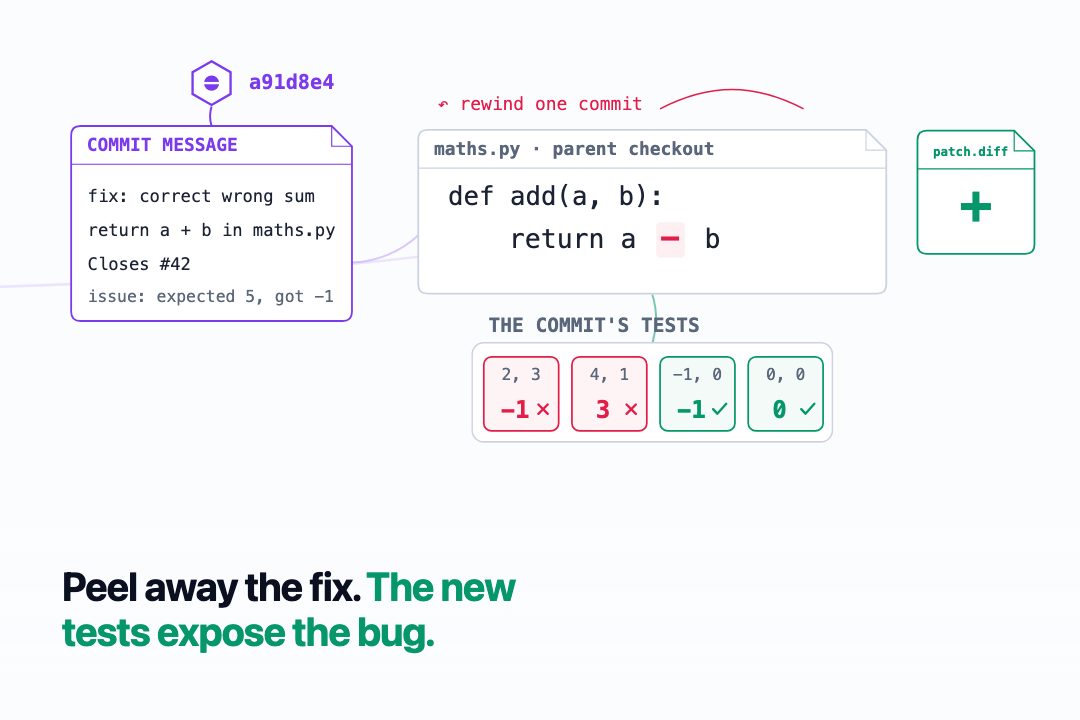
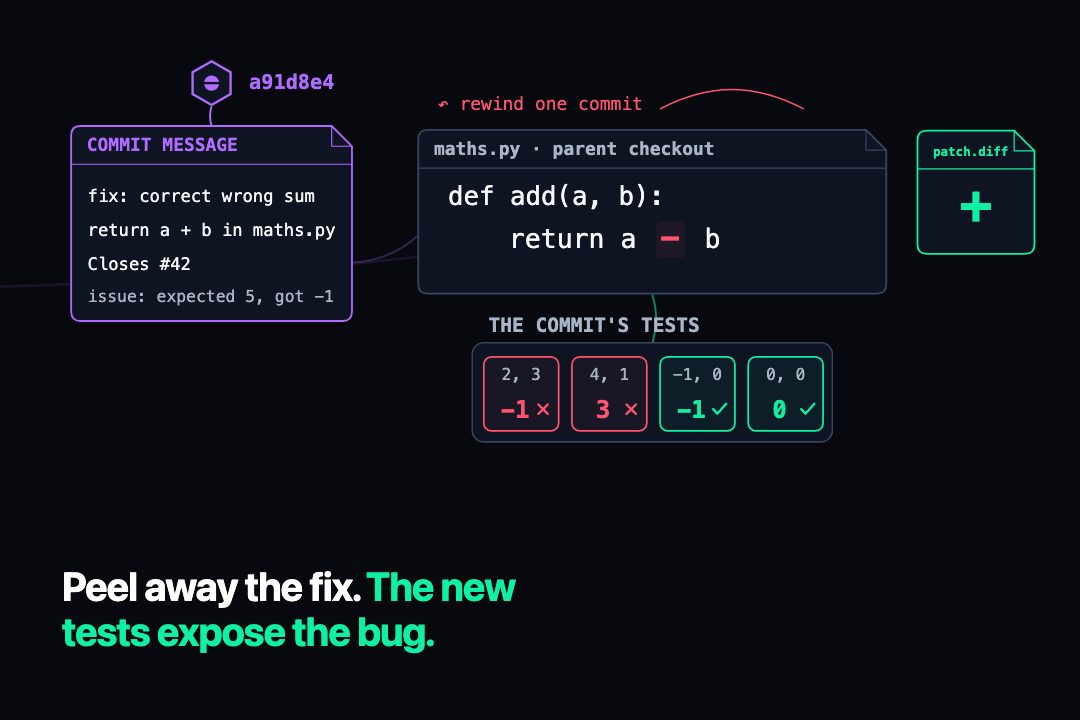
Each task is a bug-fix commit that changed both source and tests. The agent gets a problem statement an LLM rewrote from the commit message (or its linked issue) to describe only the symptom; the commit's own tests, hidden until verification, decide the reward. Use it on repositories whose fixes land as ordinary commits, including local checkouts with no pull-request history.
At a glance
| Input | A GitHub or GitLab repository, or a local git checkout |
| Task | Fix the bug a commit fixed, starting from its parent commit |
| Reward | Graded f2p_rate × p2p_rate, plus strict resolved and command_resolved flags (the pr_runtime verifier) |
| Needs an LLM | Yes: the one-time bootstrap (cached) and one call per emitted task to write the problem statement |
| Needs Docker | Yes, for bootstrap, validation and running tasks |
| Hosts | GitHub, GitLab and local paths. Linked-issue text is fetched only from GitHub and GitLab |
| Languages | The same test runners as pr_runtime: pytest, go test, cargo test, Jest, Mocha and Vitest. The reference dataset has Python and Go tasks |
| Status | Stable |
| Reference dataset | FineEnvs/repo2rlenv-commit-runtime: 100 tasks from 22 repositories |
Quickstart
repo2rlenv generate \
  --repo pallets/click \
  --pipeline commit_runtime \
  --pipeline-opt limit=100 \
  --llm anthropic/claude-sonnet-4-6 \
  --out ./tasks/click-commit-runtime
limit is the number of commits walked, newest first, so you get at most that many
tasks. The same --llm model bootstraps the repository (capped by
--max-spend-usd, default 5.0, and cached) and writes the problem statements. Each
task lands in ./tasks/click-commit-runtime/pallets__click-<sha12>/. Run the
oracle, which should score 1.0:
harbor run -p ./tasks/click-commit-runtime -a oracle --env dockerHow it works
- Bootstrap the repository once, as for
pr_runtime. See Bootstrap. - Walk the history. Clone
clone_depthcommits at--refand list up tolimitcommits onbranchwithgit log, bounded bysinceanduntil. The walk isn't first-parent, so it includes commits brought in by merges. - Filter on metadata. Skip merge commits (
skip_merge_commits), authors inexclude_authors, and messages shorter thanmin_message_wordsormin_problem_statement_words. Skip conventional-commit types that aren't fixes (chore,docs,feat,refactor,style,test,ci,build,perf,revert). Require a fix signal: afix:prefix, a linked issue (Fixes #12), or a word such as fix, bug, regression, crash, broken, incorrect, wrong or fail in the subject. - Split the diff from
git showinto a source patch and a test patch, with the same path rules aspr_runtime. Skip the commit if either is empty. - Filter on structure. Skip commits whose source changes are all under
.github/, that touch more thanmax_source_files_per_commitsource files, or whose test patch adds no test function. Skip commits with no parent. - Validate twice in the bootstrap container at the parent commit: tests with
only the test patch, then with the whole commit. Keep the commit if at least
min_fail_to_passtests flip, and cap the P2P set atmax_pass_to_pass. - Write the instruction. When the commit links an issue, fetch the issue. With
synthesize_with_llmon, an LLM rewrites the commit message and issue into a short bug report: the symptom and expected behavior, with no fix, file names, test names, hashes or issue numbers. If the call fails, the pipeline falls back to the stripped commit or issue text. - Emit the task, with the commit's source changes as the oracle.
Options
Pass each option with --pipeline-opt key=value.
| Key | Default | What it does |
|---|---|---|
limit | 50 | Maximum commits to walk. You get at most this many tasks |
since / until | none | ISO dates (2026-01-31) bounding the commit date |
branch | HEAD | Branch or ref to walk |
clone_depth | 200 | History depth to clone. Raise it when limit or the date range reaches further back |
skip_merge_commits | true | Skip commits with more than one parent |
min_message_words | 5 | Skip commits whose message has fewer words |
min_problem_statement_words | 8 | A second word-count floor on the commit message, applied before synthesis. 0 disables it |
max_source_files_per_commit | 10 | Skip commits that touch more source files |
exclude_authors | [] | Author emails to skip, as JSON: 'exclude_authors=["bot@example.com"]' |
require_new_test_funcs | true | Require the test patch to add at least one test function |
skip_ci_only | true | Skip commits whose source changes are all under .github/ |
require_fail_to_pass | true | Skip commits with fewer than min_fail_to_pass F2P tests |
min_fail_to_pass | 1 | Minimum number of F2P tests |
max_pass_to_pass | 50 | Cap on the P2P set. 0 keeps all of them |
validation_timeout_sec | 600 | Timeout for each of the two validation test runs |
skip_validation | false | Emit without running tests, with a pass/fail exit-code reward. For debugging |
synthesize_with_llm | true | Rewrite the commit or issue into a symptom-only problem statement |
llm_temperature | 0.3 | Sampling temperature for the rewrite |
max_llm_tokens | 1024 | Output token limit for the rewrite |
Output
The files match pr_runtime's output: an environment
FROM the bootstrap image at the parent commit with history scrubbed and an
egress guard, the commit's source changes as solution/patch.diff, and the hidden
test patch plus graded verifier under tests/. task.toml carries
[metadata.repo2env.commit_runtime]: commit and parent SHAs, author date and email,
subject, F2P and P2P lists, validation_status, the bootstrap image digest,
instruction_synthesized and llm_cost_usd. For a local checkout, the
reference URL is omitted. The evaluation label
starts as unverified.
Reward
Identical to pr_runtime: f2p_rate × p2p_rate in
reward.txt for training, and resolved and command_resolved in
reward-details.json for evaluation. The test files are restored and the hidden
test patch re-applied before scoring, so editing tests doesn't help.
Yield and cost
No generation denominator or cost ledger was recovered, so yield is unmeasured.
The main driver is how a repository lands its fixes. A commit yields a task only
when it carries both the fix and a test that exercises it. Squash-merged pull
requests and direct commits usually do. Merge commits themselves are skipped, and
branches merged with merge commits often split the fix and its test into separate
commits, so neither shows a failing-to-passing test. On those repositories, use
pr_runtime. Repository health matters as much as it does for
pr_runtime: the suite has to run in the bootstrap container.
Cost is one bootstrap per repository, two test runs per candidate, and one problem-statement call per emitted task.
All 100 reference tasks carry generation-time validation_status = "verified",
but a Harbor oracle run over all 100 wasn't recovered. An earlier 52-task cohort,
built before instruction synthesis, has separate evidence: 52 oracle passes, 47
clean-command passes and 47 with a regression guard. No reliable solve rate was
recovered. See native results.
Limits
- A generated task isn't a verified environment. Run the controls: the oracle
should score 1.0 and a no-op agent (
-a nop) 0. Record the outcome as an evaluation label; see Quality. - Commits are unreviewed. Nobody signed off on a commit the way a PR is reviewed, so the filters and validation do all the work. Review instructions and verifiers before you rely on a task.
- The problem statement is model-written. The rewrite is told to describe only the symptom, but it can still leak the fix or come out vague.
- History is shallow. Only
clone_depthcommits are cloned, and the oldest commit in a shallow clone has no parent, so it's skipped. - Runtime limits carry over. Python needs pytest output (#167), and the egress guard doesn't block the Go module proxy or crates.io (#160).
llm_cost_usdis cumulative for the run, not the cost of that task.- Tasks depend on a local image until you publish them with
repo2rlenv push.
Related
- RFC 0003: commit_runtime
- Reference dataset and its release history
pr_runtime: the PR-based sibling, with the verifier detailsr2e_gym: the research recipe for commit history- Tasks, Rewards and Run with Harbor
- Inspired by the SWE-GEN curation in R2E-Gym (Jain et al., 2025). No code is copied.
Implementation notes
Source: pipelines/commit_runtime.py
and git_local.py.
Patch splitting, validation, the eval script and the verifier are reused from
pr_runtime.
- The walk runs
git log --max-count=<limit>onbranchin the shallow clone. The pipeline warns when the candidate count reachesclone_depth, since the clone may be truncating history. - When the P2P set exceeds
max_pass_to_pass, tests whose names mention a changed file are kept first, then the rest fill up to the cap. - The synthesized statement must be at least 10 words, or the pipeline uses the
fallback text. The fallback strips the conventional-commit prefix, closing
keywords, commit hashes, PR and issue links,
(#123)squash suffixes andowner/repo#123cross-references, then trims template sections. - Task IDs are
<owner>__<repo>-<first 12 characters of the SHA>. ThereferenceURL points atgithub.com/<owner>/<repo>/commit/<sha>, or/-/commit/on GitLab.