pr_diff
Turn merged pull requests into tasks scored by how closely the agent's patch matches the real fix.
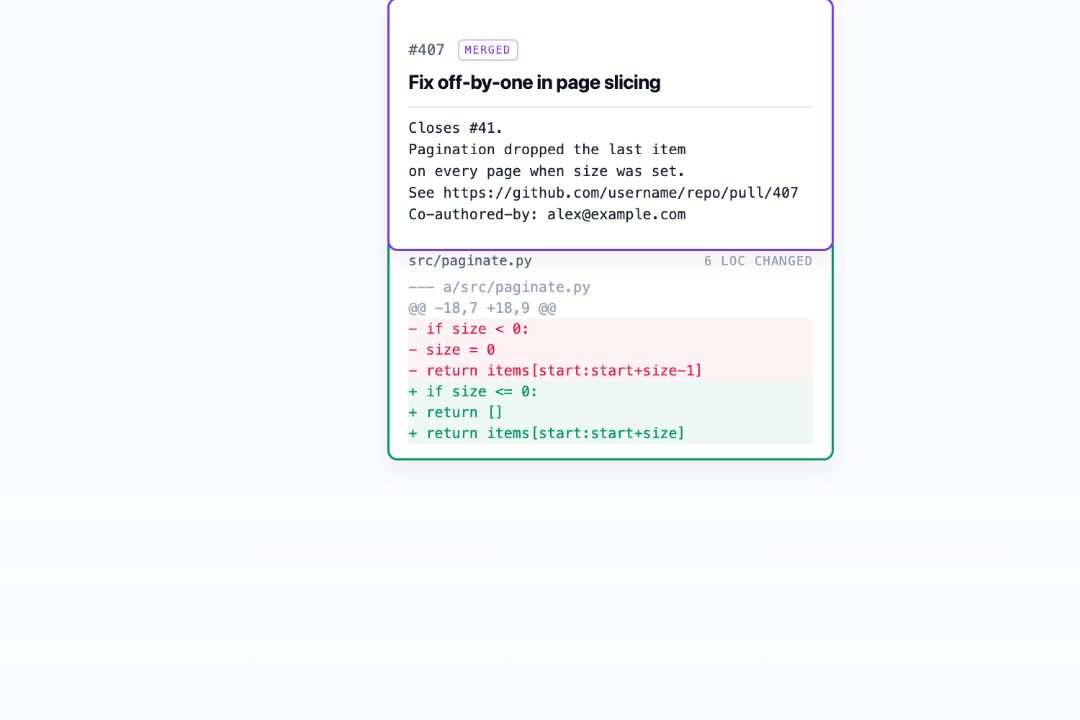
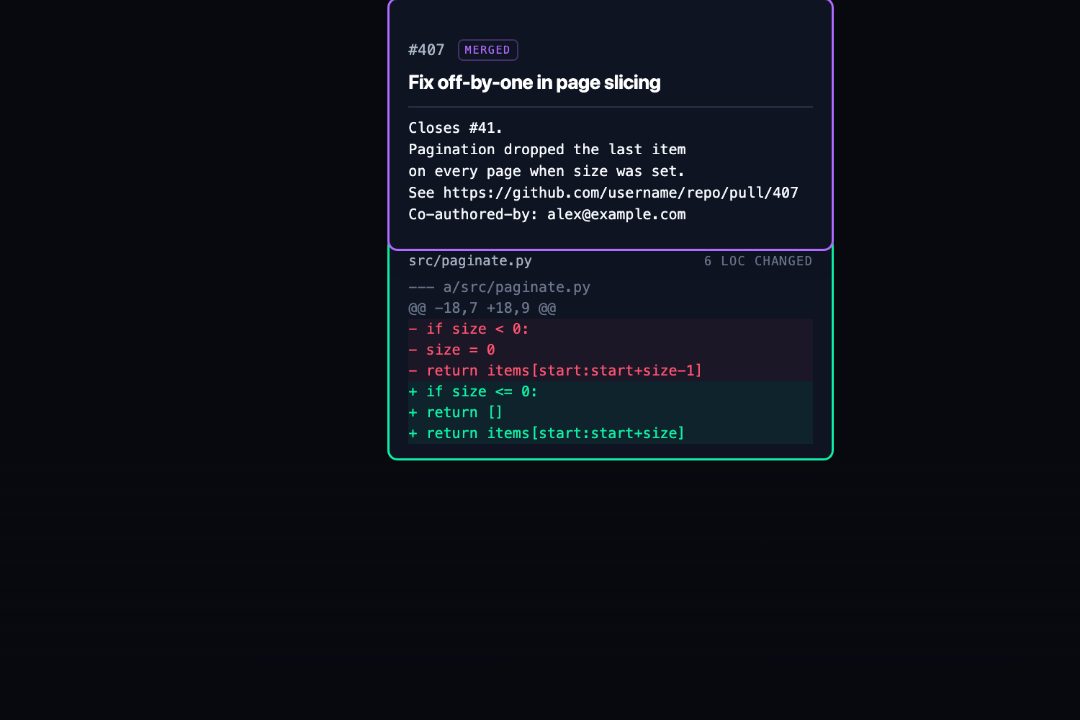
Each task is a merged pull request, rewound to its base commit: the agent gets the
PR's title and description and edits the repository to resolve it. A verifier
compares the agent's diff with the merged diff and, when you pass it a key, asks an
LLM judge whether the patch addresses the issue. Generation needs no Docker and no
LLM, so pr_diff is the cheapest way to get many tasks out of a repository.
At a glance
| Input | A GitHub or GitLab repository with merged PRs |
| Task | Resolve the issue described in a merged PR, starting from its base commit |
| Reward | Weighted diff similarity in [0, 1] against the merged diff, plus an optional LLM judge |
| Needs an LLM | No at generation. The judge is optional, at verify time |
| Needs Docker | No at generation. Running a task builds a small python:3.12-slim image |
| Hosts | GitHub (needs gh on PATH) and GitLab |
| Languages | Any, since scoring is text-based. The reference dataset spans Python, JavaScript/TypeScript, Go and Rust |
| Status | Stable |
| Reference dataset | FineEnvs/repo2rlenv-pr-diff: 181 tasks from 26 repositories |
Quickstart
repo2rlenv generate \
  --repo pallets/click \
  --pipeline pr_diff \
  --pipeline-opt limit=5 \
  --out ./tasks/click-pr-diff
limit caps how many merged PRs are listed, so you get at most five tasks, one
directory each (./tasks/click-pr-diff/pallets__click-<pr>/). The command exits
with status 1 if every PR is filtered out. Check the tasks, then run the oracle,
which applies the merged diff:
repo2rlenv validate ./tasks/click-pr-diff --oracle
harbor run -p ./tasks/click-pr-diff -a oracle --env docker
To score a real agent, pass the judge key to the verifier with --ve; --ae only
reaches the agent:
harbor run -p ./tasks/click-pr-diff \
  -a claude-code -m anthropic/claude-sonnet-4-6 \
  --ak max_budget_usd=2.00 \
  --ae ANTHROPIC_API_KEY=$ANTHROPIC_API_KEY \
  --ve ANTHROPIC_API_KEY=$ANTHROPIC_API_KEY \
  --env docker
How it works
- List merged PRs.
gh pr list --state mergedon GitHub, or the merge-request API on GitLab, newest first. The listing over-fetches three timeslimitso that draft andsince/untilfiltering still leaves up tolimitPRs. - Filter on metadata. Skip drafts (
skip_drafts), PRs with no changed files or more thanmax_files_per_pr, and PRs without a merge timestamp. - Fetch the diff with
gh pr diff(or the GitLab equivalent). Empty diffs and fetch failures are skipped. - Filter on content. Skip diffs that only touch tests or only touch docs,
titles that start with
Revert, diffs with fewer thanmin_loc_changedchanged lines, and PRs whose description is empty after stripping and whose title has fewer than five words. - Write the instruction from the PR title and description, with closing keywords, issue and PR links, GitHub URLs, commit trailers and squash suffixes removed (see Implementation notes).
- Calibrate. Compute the reward an empty patch would get (the no-op baseline) and a difficulty bucket from the diff size.
- Emit the task. The environment is
python:3.12-slimwith git and the repository checked out at the base commit, with git history past that commit removed. The oracle and verifier go intests/, which Harbor uploads only at verify time, so the agent's image never contains the answer.
Options
Pass each option with --pipeline-opt key=value.
| Key | Default | What it does |
|---|---|---|
limit | 50 | Maximum merged PRs to list. You get at most this many tasks |
since / until | none | ISO dates (2026-01-31) bounding the merge date |
max_files_per_pr | 5 | Skip PRs that change more files than this |
min_loc_changed | 3 | Skip PRs whose diff changes fewer +/- lines than this |
skip_drafts | true | Skip draft PRs |
emit_harbor_env | true | Write environment/, tests/test.sh and the verifier files. false writes text-only tasks (task.toml, instruction.md, solution/) for trainers that score diffs themselves |
diff_format | unified | Recorded in task metadata. The oracle is always the unified diff from the host |
state | merged | Accepts merged or all; listing currently always uses merged PRs |
context_window_loc | 200 | Accepted but not used by the current pipeline |
Output
task.toml: Harbor 1.0 task (name = "<org>/pallets__click-<pr>", agent timeout 1,800 s, verifier timeout 300 s) with provenance, calibration and an evaluation label under[metadata.repo2env]. The label starts asunverified.instruction.md: the stripped PR title and description, plus a short task statement.environment/Dockerfile:python:3.12-slim, git, and the repository at the base commit. An optionalGITHUB_TOKENorGITLAB_TOKENbuild argument clones private repositories; the remote URL is reset afterwards.solution/patch.diff: the merged diff (the oracle).solution/solve.sh: appliespatch.diff; Harbor's oracle agent runs it.tests/test.sh: captures the agent's edits withgit add -Aandgit diff --cached <base>, then runs the verifier.tests/verifier.py: the standalone six-component scorer (Python standard library only).tests/oracle.patch: the reference diff the verifier compares against.tests/instruction.md: the verifier's copy of the instruction, for the judge.
The per-task metadata looks like this:
[metadata.repo2env]
pipeline = "pr_diff"
repo = "pallets/click"
ref = "<base commit sha>"
reference = "https://github.com/pallets/click/pull/<pr>"
reward_kinds = ["diff_similarity"]

[metadata.repo2env.pr_diff]
pr_merged_at = "<timestamp>"
diff_format = "unified"
context_files = ["src/click/…", "tests/…"]

[metadata.repo2env.reward_calibration]
baseline_reward = 0.0
loc_changed = 95
difficulty = "large"
Multi-component reward
The verifier scores the agent's diff against the oracle with six components and combines them as a weighted average:
| Component | Range | Weight | What it measures |
|---|---|---|---|
format_valid | 0 or 1 | 0.00 | The diff has a diff --git header and at least one change line. Kept as a guard |
size_sanity | [0, 1] | 0.08 | min(oracle_lines, predicted_lines) / max(…). Catches no-op and sprawling patches |
file_targeting | [0, 1] | 0.12 | F1 over the sets of changed files, so missing an oracle file costs more than touching an extra one |
region_overlap | [0, 1] | 0.20 | Fraction of oracle hunks with a predicted edit within five lines in the same file |
similarity | [0, 1] | 0.10 | difflib.SequenceMatcher ratio over +/- lines only, so unchanged context earns nothing |
llm_judge | [0, 1] or none | 0.50 | An LLM rates whether the patch plausibly addresses the issue, without grading similarity to the oracle |
The result is clipped to [0, 1]. If size_sanity is below 0.10, the reward is
capped at 0.40, so a lenient judge can't inflate a patch that is wildly the wrong
size. An empty patch scores 0.
When the judge doesn't return a score, its weight is redistributed across the
other components. Override any weight per run with R2E_W_FORMAT, R2E_W_SIZE,
R2E_W_FILE, R2E_W_REGION, R2E_W_SIM or R2E_W_JUDGE, passed with
harbor run --ve.
The verifier removes any existing reward files, then writes the score to
/logs/verifier/reward.txt and the breakdown (final_reward, components,
weights, judge_model, judge_endpoint, judge_status) to
/logs/verifier/reward-details.json.
LLM judge
Setting (via --ve) | Effect |
|---|---|
ANTHROPIC_API_KEY | Enables the default judge, claude-haiku-4-5-20251001 on the Anthropic API |
R2E_JUDGE_MODEL | Picks a different model |
R2E_JUDGE_ENDPOINT | Sends the request to an OpenAI-compatible server (<endpoint>/chat/completions, temperature 0) instead. R2E_JUDGE_MODEL is then required, and ANTHROPIC_API_KEY is never sent there |
R2E_JUDGE_API_KEY | Bearer token for the custom endpoint; a placeholder is sent when unset |
judge_status records the outcome: ok, no_api_key, no_judge_model,
empty_predicted, network, parse or missing_score. To use a self-hosted
judge, start a server on the host and route the verifier to it:
harbor run -p ./tasks/click-pr-diff \
  -a claude-code -m anthropic/claude-sonnet-4-6 \
  --ae ANTHROPIC_API_KEY=$ANTHROPIC_API_KEY \
  --ve R2E_JUDGE_ENDPOINT=http://host.docker.internal:8000/v1 \
  --ve R2E_JUDGE_MODEL=Qwen/Qwen3.5-4B \
  --env docker
host.docker.internal resolves on Docker Desktop (macOS, Windows, WSL2). On a
Linux Docker daemon, use the host's LAN IP instead.
Calibration baseline
reward_calibration.baseline_reward is the reward an empty patch gets against
the task's oracle, computed without the judge. Normalize with
calibrated = (raw - baseline) / (1 - baseline); a negative value means the agent
did worse than doing nothing. With the current components the baseline is 0.
Difficulty bucketing
reward_calibration.difficulty buckets the oracle by changed lines: trivial
(5 or fewer), small (6–20), medium (21–80) and large (more than 80), with the
raw count in loc_changed. metadata.difficulty in task.toml uses the same
buckets, with trivial written as easy.
Scoring outside Harbor
For text-only training loops, score a predicted diff directly. The single-component SWE-RL-style similarity is:
from repo2rlenv.reward import calculate_diff_similarity_reward

reward, meta = calculate_diff_similarity_reward(oracle_diff, predicted_diff)
For the full six-component score, import the functions in
_pr_diff_verifier.py.
See Rewards for how this compares with the test-based rewards.
Yield and cost
No complete candidate count or generation cost was recovered for the reference
dataset, so there's no measured yield. Yield depends on the filters alone:
there's no execution gate, so every listed PR that survives them becomes a task. The run summary
counts each skip reason (draft, too_many_files, test_only_diff,
docs_only_diff, revert_pr, diff_too_small, instruction_too_thin, and so on).
Generation makes no model calls; the only model cost is one judge call per scored
attempt.
An earlier 23-trial Claude Sonnet 4.6 pilot on the first 100-task release had a median reward of 0.71 (range 0.16–0.98). These are continuous scores, not a solve rate. See native results.
Limits
- A generated task isn't a verified environment. Run the controls: the oracle
should score 1.0 (exactly 1.0 without a judge) and a no-op agent (
-a nop) 0. Record the outcome as an evaluation label; see Quality. - The published dataset predates oracle isolation. Tasks generated before #145, including the 181-task reference dataset, bake the oracle into the agent's image. Repairing that dataset is tracked in #155. Regenerate tasks, and rebuild cached images, before you train or evaluate on them.
- Similarity isn't correctness. A valid fix that differs from the merged one scores lower on the deterministic components. The judge carries half the weight to offset this, but judges are noisy, especially small self-hosted ones.
- No egress guard. Git history is removed, but
pr_diffdoesn't ship the network denylist the runtime pipelines use (see contamination defenses). An agent with web access can look up the merged PR. - The instruction is written by the fixer. Stripping removes links and references, not prose, so some descriptions still explain the approach.
- GitLab listing sees at most the newest 100 merged MRs, so a
limitabove about 33 won't reach older ones.
Related
- RFC 0001: pr_diff
- Reference dataset and its release history
pr_runtime: the same PRs, verified by running their tests- Tasks, Rewards and Run with Harbor
- Inspired by SWE-RL (Wei et al., 2025). The verifier is an independent reimplementation.
Implementation notes
Source: pipelines/pr_diff.py
and pipelines/_pr_diff_verifier.py.
Instruction info-leak strip
The instruction builder removes these pattern families from the PR title and body.
Composite forms run first, so no orphaned Closes keywords or empty [text]()
brackets are left behind:
| Pattern | Example |
|---|---|
| Closing keywords | Closes #42, Fixes #1, #2 |
| Linkbacks | See #99, Refs #7, Follow-up to #42 |
| Markdown issue links | [#1234](https://github.com/o/r/issues/1234), Closes [#1234](url) |
| Markdown links to GitHub PRs, issues or commits | [my analysis](https://github.com/o/r/pull/1234) |
| Bare GitHub URLs | https://github.com/o/r/pull/42, including redirect.github.com |
| Commit trailers | Co-authored-by:, Signed-off-by:, Reviewed-by:, Acked-by: |
| Title squash suffixes | Fix the bug (#1234), (fixes #1800) |
Environment and verifier details
- The Dockerfile clones over HTTPS (SSH and
http://inputs are rewritten), fetches the base commit, runsgit reset --hardandgit clean, then scrubs history: it removesorigin, deletes every other branch and tag, expires the reflog and garbage-collects, keeping only the base commit reachable. - No agent tooling is installed. Harbor's agent adapter installs what it needs when the container starts, so the same task works with any harness.
test.shstages new files before diffing (git add -A). Without that, files the agent creates wouldn't count toward file targeting or region overlap.- The judge prompt truncates the instruction, oracle and prediction to 4,000
characters each and asks for a JSON
score. The default Anthropic route keeps the provider's sampling defaults, which the weights were tuned against; custom endpoints are pinned to temperature 0. - The default weights were retuned after a 23-task pilot:
format_validwas 1.0 on every evaluated task (no signal), andsimilaritycorrelated strongly withregion_overlap, so the judge took the freed weight.