cve_patches
Turn published security advisories into tasks where the agent patches a real vulnerability and a regression test decides the reward.
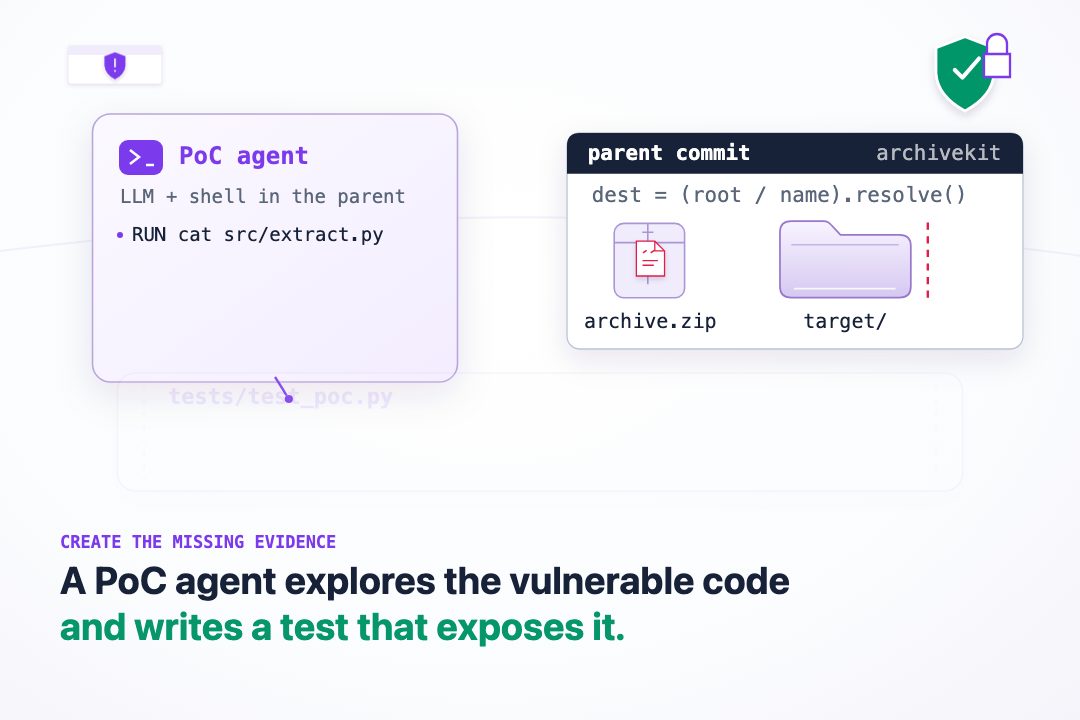
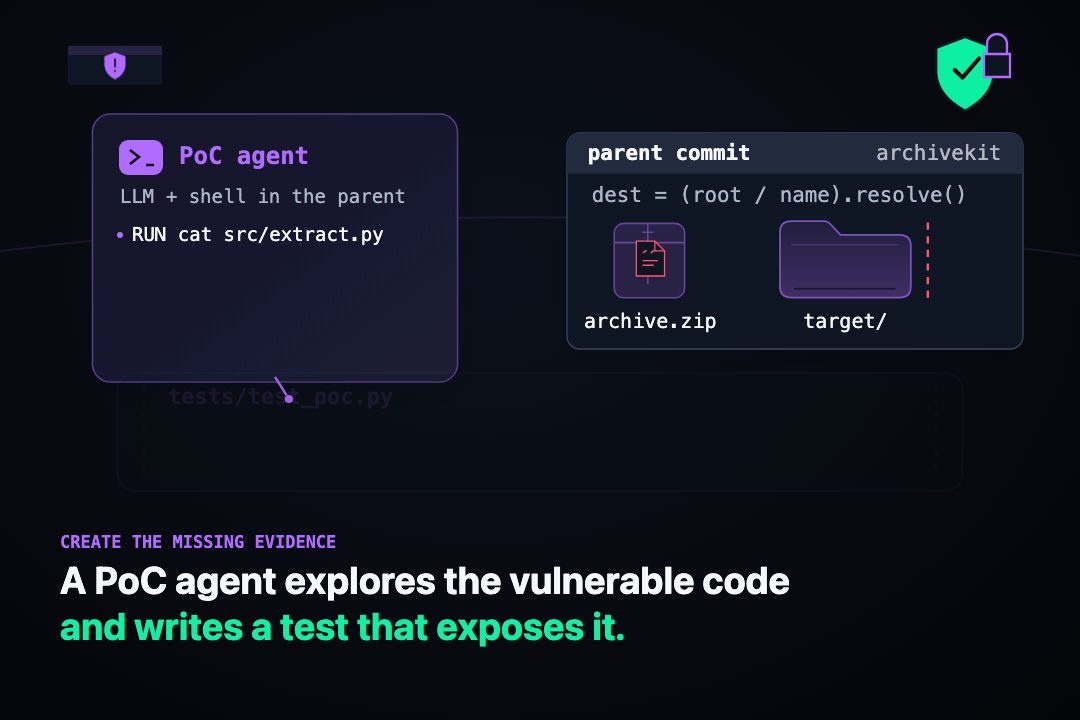
Each task is a published vulnerability in the target repository: the agent gets the advisory with every pointer to the fix removed and patches the code at the commit before the fix. The reward comes from a regression test that fails on the vulnerable code and passes on the fixed code: the fix commit's own test when it ships one, otherwise a proof-of-concept (PoC) test that an LLM agent writes in the vulnerable sandbox. Advisories come from OSV, which links each one to its fixing commit.
At a glance
| Input | A GitHub repository whose package has advisories in OSV that link fix commits in that repository |
| Task | Patch the vulnerability described by a stripped advisory, starting from the parent of the fix commit |
| Reward | Graded f2p_rate × p2p_rate, plus strict resolved and command_resolved flags (the pr_runtime verifier) |
| Needs an LLM | Yes: the one-time bootstrap (cached), and PoC test synthesis when a fix ships no test |
| Needs Docker | Yes, for bootstrap, validation, PoC synthesis and running tasks |
| Hosts | GitHub only |
| Languages | Any test runner pr_runtime supports when the fix commit ships a test. PoC synthesis is Python only |
| Status | Experimental |
| Reference dataset | FineEnvs/repo2rlenv-cve-patches: 19 tasks from six repositories |
Quickstart
repo2rlenv generate \
  --repo pallets/werkzeug \
  --pipeline cve_patches \
  --pipeline-opt limit=2 \
  --llm anthropic/claude-sonnet-4-6 \
  --out ./tasks/werkzeug-cve
The example uses pallets/werkzeug because OSV lists advisories with fix commits
for it; most repositories have only a handful. limit is the number of tasks to
emit. The first run bootstraps the repository (capped by --max-spend-usd,
default 5.0, and cached), and each advisory without a shipped test can spend up to
poc_agent_max_spend_usd (default 1.5) on PoC synthesis. Each task lands in
./tasks/werkzeug-cve/pallets__werkzeug-cve-<CVE id>/. Run the oracle, which
should score 1.0:
harbor run -p ./tasks/werkzeug-cve -a oracle --env dockerHow it works
- Bootstrap the repository once. See Bootstrap.
- Query OSV (
/v1/query) for the package:osv_package, or the repository name in lower case, inosv_ecosystem, or an ecosystem guessed from the owner (PyPI unless the owner is a known npm or crates.io organization). - Scope the advisories. Keep those at or above
min_severitythat reference agithub.com/<owner>/<repo>/commit/<sha>URL for this repository. Links to forks are ignored; when an advisory lists several commits, the first is used. - Fetch the fix and its parent commit through the GitHub API, and split the
diff into source and test patches. Skip empty source patches and fixes that
touch more than
max_source_files_per_fixsource files. - Build the oracle test. If the fix ships a test, validate it as
pr_runtimedoes: tests at the parent with only the test patch, then with the whole fix. Otherwise, if the repository is Python,synthesize_poc_testis on and--llmis set, synthesize a PoC test and validate it the same way on a clean checkout. - Require an oracle. With
require_fail_to_passon, advisories that end with fewer thanmin_fail_to_passF2P tests are dropped asno_verifiable_oracleinstead of becoming tasks nobody can score. The P2P set is capped atmax_pass_to_pass. - Write the instruction from the advisory's summary, severity, CWE tags and details, with fix pointers removed, plus a request to work the fix out from the code rather than fetch the upstream patch.
- Emit the task, with the fix's source changes as the oracle and the shipped or
synthesized test hidden inside
tests/test.sh.
PoC synthesis
By default (poc_agent), an LLM gets a shell in the sandbox, reset to the
vulnerable parent commit, plus the advisory and the fix diff, which it may study
but not apply. It replies with one command per turn: it explores how existing
tests import the package, writes test_cve_poc.py in the test directory, runs
pytest, and finishes only after seeing the test fail for the vulnerability's
reason. It stops after 14 turns or when it has spent poc_agent_max_spend_usd.
With poc_agent=false, a one-shot prompt that includes the vulnerable source of up
to two changed files writes the test instead, retried up to poc_max_attempts
times. Either way, the test counts only if validation shows it failing before the
fix and passing after it.
Options
Pass each option with --pipeline-opt key=value.
| Key | Default | What it does |
|---|---|---|
limit | 50 | Number of tasks to emit |
osv_ecosystem | guessed | OSV ecosystem, such as PyPI, npm, crates.io, Go or Maven |
osv_package | repository name | Package name in that ecosystem |
min_severity | low | Lowest severity to keep: low, medium, moderate, high or critical |
max_source_files_per_fix | 50 | Skip fixes that touch more source files |
synthesize_poc_test | true | Synthesize a PoC test when the fix ships none (Python only) |
poc_agent | true | Use the agent with a shell in the sandbox; false uses the one-shot prompt |
poc_agent_max_spend_usd | 1.5 | Model budget per advisory for the PoC agent |
poc_max_attempts | 2 | Attempts for the one-shot prompt |
llm_temperature | 0.3 | Sampling temperature for the one-shot prompt |
max_llm_tokens | 4096 | Output token limit for the one-shot prompt |
require_fail_to_pass | true | Drop advisories without at least min_fail_to_pass F2P tests. With false, they're emitted with a pass/fail exit-code reward |
min_fail_to_pass | 1 | Minimum number of F2P tests |
max_pass_to_pass | 50 | Cap on the P2P set. 0 keeps all of them |
validation_timeout_sec | 600 | Timeout for each validation test run |
skip_validation | false | Skip validation and PoC synthesis. For debugging; pair it with require_fail_to_pass=false, or every advisory is dropped |
require_new_test_funcs | false | Accepted but not used by the current pipeline |
Output
The files match pr_runtime's output: an environment
FROM the bootstrap image at the parent commit with history scrubbed and an
egress guard, the fix's source changes as solution/patch.diff, and the hidden
test patch plus graded verifier under tests/. task.toml has
difficulty = "hard", category = "security", the fix commit URL as reference,
and [metadata.repo2env.cve_patches]: CVE and OSV ids, aliases, CWE ids, severity,
publication date, fix and parent commits, F2P and P2P lists, validation_status
(verified for a shipped test, poc_synthesized for a synthesized one),
poc_synthesized, the bootstrap image and llm_cost_usd. The
evaluation label starts as unverified.
Reward
Identical to pr_runtime: f2p_rate × p2p_rate in
reward.txt, and resolved and command_resolved in reward-details.json. The
test files are restored and the hidden test patch re-applied before scoring, so
editing or deleting the PoC test doesn't help.
Yield and cost
The reference dataset lists 19 tasks from six repositories: waitress 8, werkzeug 3, requests 3, mistune 2, flask 2 and sqlparse 1. Its cached manifest has no per-task validation results or F2P/P2P counts, and no candidate count or cost ledger was recovered, so yield is unmeasured. See native results.
What drives yield:
- Advisory supply. Most repositories have few advisories that link a fix commit, so building many tasks means mining many repositories.
- Repository health. The suite has to collect and run in the bootstrap container; suites that need network access yield nothing.
- Oracle tests. Few fixes ship a regression test. PoC synthesis supplies one for Python repositories, but vulnerabilities that depend on timing, network or environment rarely get a deterministic test and are dropped.
Cost is one bootstrap per repository, up to poc_agent_max_spend_usd per advisory
that needs a PoC test, and two test runs per validated test.
Limits
- A generated task isn't a verified environment. Run the controls: the oracle
should score 1.0 and a no-op agent (
-a nop) 0. Record the outcome as an evaluation label; see Quality. For the 19 published tasks, validation evidence is unavailable. - PoC tests are model-written. Validation proves a test flips with the fix, not that it exercises the vulnerability rather than an incidental behavior change. Review each synthesized test.
- Known fixes are easy to find. The instruction drops advisory ids, links and fixed versions, and the egress guard blocks PyPI and GitHub, but the fix is public and the agent's own model may know it. The guard also doesn't block the Go module proxy or crates.io (#160). For evaluation, run without network access.
- GitHub and OSV only. Advisories need a fix-commit link in this repository.
Records without a
database_specific.severitylabel (for example, those with only a CVSS vector) are skipped, even atmin_severity=low. - The ecosystem guess defaults to PyPI. Set
osv_ecosystemandosv_packagefor other packages. - Runtime limits carry over from
pr_runtime, including the pytest-only Python parser (#167). llm_cost_usdis cumulative for the run, not the cost of that task.
Related
- RFC 0006: cve_patches
- Reference dataset and its inventory
pr_runtime: the validation harness and verifier this pipeline reuses- SEC-bench recipe proposal, which is deferred
- Tasks, Rewards and Run with Harbor
- Inspired by PatchSeeker and CVE-Bench (Zhu et al., 2025). OSV's structured fix-commit references replace an LLM-based CVE-to-commit mapper. No code is copied.
Implementation notes
Source: pipelines/cve_patches.py,
pipelines/_poc_agent.py
and osv.py.
The advisory strip runs in three passes:
| Pass | Removes |
|---|---|
| Sections | Headings such as Workarounds, Remediation, Mitigation, References, Fix, Patches, Solutions, Credits, Resources, Links and See also, with their bodies |
| Lines | Lines that say to apply, see, backport or cherry-pick something, that say the issue was fixed or patched in a version, or that say to upgrade |
| Tokens | URLs, CVE and GHSA ids, PR, pull, commit and issue references, #NN references, and 7–40 character hex strings |
- The ecosystem guess maps owners such as
pallets,pypa,psf,djangoandencodeto PyPI,nodejs,expressjsandfacebookto npm, andrust-langandtokio-rsto crates.io. Every other owner defaults to PyPI. - Severity ranks are
LOW1,MEDIUMandMODERATE2,HIGH3 andCRITICAL4. - The PoC agent's test path is converted to a repository-relative new-file diff, which becomes the task's test patch.
- Task IDs are
<owner>__<repo>-cve-<CVE id>, falling back to the OSV id when the advisory has no CVE alias.