
Architecture
This page explains how serge is put together — its components, the execution
backends that run the LLM work, and the two deployment flavors (Docker and
Kubernetes). For the step-by-step review lifecycle see
How it works; for the trust model see
Security and Security architecture.
The big picture
serge is an orchestrator. Its long-lived process owns the durable state and the credentials — the SQLite job store, the GitHub App private key, the OAuth / session secrets, and LLM keys — and decides when a review or task runs and what gets published. The actual LLM loop (fetch diff → prompt → tool calls → draft) can either run in that same process or be pushed out into a short-lived runner pod, depending on how you deploy. Either way, the model only ever proposes output; serge validates it and publishes.
                         ┌───────────────────────────────────────────┐
   GitHub  ── comment ──▶│  serge (orchestrator: reviewbot-web/-app)   │
   / webhook / OIDC      │  • trigger gate    • SQLite job store       │
                         │  • GitHub App auth • provider configs       │
                         │  • draft/publish   • per-job secrets        │
                         └───────────────┬─────────────────────────────┘
                                         │ run the LLM loop …
                        ┌────────────────┼─────────────────────┐
                        ▼                ▼                     ▼
                 in-process        docker runner         kubernetes pod
                 (same process)    (docker run)          (one Job / request)
Entry points
serge ships three entry points around one shared core (reviewbot/reviewer.py):
| Command | Role | Where it runs |
|---|---|---|
reviewbot-action |
GitHub Action runner; reads GITHUB_EVENT_PATH |
GitHub’s ephemeral runner |
reviewbot-app |
Flask GitHub App webhook server | Your server |
reviewbot-web |
FastAPI staged web app + POST /webhook + write-capable POST /tasks |
Your server |
The Action is self-contained: it runs on GitHub’s disposable runner with a job-scoped token, so the runner itself is the isolation boundary. The webhook and web app are the persistent, hosted deployments — everything below about execution backends and deployment flavors is about those.
Core components
| Component | File | Responsibility |
|---|---|---|
| Reviewer core | reviewbot/reviewer.py |
Annotate diff, prompt the LLM, validate inline comments against real diff positions, publish or draft |
| Trigger gate | reviewbot/triggers.py |
Decide whether an event should start a review (event type, author association, trigger phrase, PR state) |
| Tools + sandbox | reviewbot/tools.py, sandbox.py |
Read-only repo browse tools and repo helper tools, each executing subprocess wrapped in bubblewrap |
| Clone cache | reviewbot/clone_cache.py |
Shallow checkout of the PR head with an upstream .ai/ overlay; standalone (self-contained) clones for pods |
| Store | reviewbot/store.py |
Embedded SQLite: jobs, drafts, provider configs, cached installation tokens |
| GitHub auth | reviewbot/github_auth.py |
Mint short-lived installation tokens from the App private key |
| Launchers | reviewbot/launcher.py, k8s_sandbox.py |
Build the runner spec and start a docker container or a Kubernetes Job |
| Runners | reviewbot/task_runner.py, review_runner.py |
The in-pod entry points that do the whole loop and stream results back |
Execution backends
serge has two independent backend selectors — one for write-capable
tasks and one for PR reviews. Both default to inprocess, so a
fresh install runs the entire loop inside serge’s own thread pool with no
Docker and no Kubernetes.
| Setting | Env var | Values | Default |
|---|---|---|---|
| Task execution | TASK_EXECUTION |
inprocess | docker | kubernetes |
inprocess |
| Review execution | REVIEW_EXECUTION |
inprocess | docker | kubernetes |
inprocess |
inprocess— the loop runs in a worker thread inside serge. Simplest; this is the legacy path and the default.docker— serge doesdocker runon a runner image per request, blocks on the worker thread, and finalizes inline.kubernetes— serge creates one short-lived Kubernetes Job per request, watches it out-of-band, and finalizes when the runner calls back.
The docker and kubernetes backends share the same runner image, spec
format, and HTTP callback — they differ only in how the runner process is
started. Inline PR-comment follow-ups always stay in-process regardless of the
setting.
Kubernetes is never mandatory. The
kubernetesclient is imported lazily, the pod watcher no-ops when there are no pod tasks, and every k8s-only feature is gated — so a Docker or in-process deployment never needs the cluster libraries.
Sandboxing vs. execution backend
Two other knobs control how subprocesses within a review/task are sandboxed — they are separate from the execution backend above:
HELPER_SANDBOX(require|auto|off) wraps the read-only helper tools, the.ai/context-script, and the pip-install hook in bubblewrap. Production setsrequire. See Security architecture.TASK_SANDBOX_BACKEND(bwrap|docker|kubernetes|auto) wraps the in-loop normalize command when tasks run in-process.
Inside a runner pod both are forced off: the ephemeral pod plus its
allowlist-egress firewall is the isolation boundary, so there is no nested
sandbox.
Pods (the Kubernetes backend)
When TASK_EXECUTION=kubernetes (and, for reviews, reviewPods=true →
REVIEW_EXECUTION=kubernetes), serge becomes a pure orchestrator and all LLM
work happens in per-request pods.
Lifecycle of a pod
  request ─▶ serge mints installation token + callback token
             │
             ├─ build spec (request + GitHub token + LLM settings + callback)
             ├─ create Job (batch/v1, backoffLimit 0, ttlSecondsAfterFinished 300)
             ├─ create per-job Secret (task.json, ownerRef→Job) → returns immediately
             │
             ▼
   runner pod: read /etc/serge/task.json
             ├─ clone repo (standalone, self-contained) via the egress proxy
             ├─ run the LLM loop (tools, in-process normalize for tasks)
             ├─ POST each event  ──────────────▶  serge callback (SSE relay)
             └─ POST terminal result ──────────▶  serge: finalize + publish/draft
             │
   serge Job watcher (every 5s, k8s only): reconciles crashes, reaps the Job
- Launch (non-blocking). serge mints a short-lived GitHub installation token and a per-job callback bearer token, serializes them plus the request and resolved LLM settings into a spec, creates the Job, then the Secret, and returns without parking a thread.
- Per-job Secret. The spec is projected read-only into the pod at
/etc/serge/task.json. The Secret carries anownerReferenceback to the Job, so it is garbage-collected with the Job even on a crash. - The runner pod (
reviewbot-task-runner) dispatches onrequest_type:review→review_runner.run, otherwisetask_runner.run. It rebuilds aConfigthat has no App private key and no web-auth env, clones into its ownemptyDir(no shared PVC), runs the loop, and POSTs events and a terminal payload back over the authenticated callback. A task runner publishes its PR itself; a review runner only ships an encoded draft — serge publishes on human approval (or auto-publishes for webhook reviews). - Watcher + idempotent finalize. An in-process asyncio watcher polls the Job status every 5s (only when there are Kubernetes pod tasks). Finalization is guarded so it happens exactly once whether it’s triggered by the happy- path callback or by the watcher detecting a crashed/timed-out pod.
- Reaping. serge deletes the Job (and its Secret) on completion;
ttlSecondsAfterFinishedis the backstop if a delete is missed.
The Pods page
The web app exposes a Pods admin page (/admin/pods, admin-gated) that lists
running pods — joining live Kubernetes pods with serge’s tracked tasks, so both
orphaned pods (after a serge restart) and just-launched ones appear — and offers
a kill action (POST /admin/pods/kill) as the manual stop for a runaway Job.
Network isolation
A runner pod holds a live GitHub token and LLM key while running arbitrary
repository build code (e.g. make style). Its egress is therefore locked down
by two Kubernetes NetworkPolicy objects and a forward proxy:
- The task-pod NetworkPolicy denies all egress except to the
serge-egressproxy, kube-dns, and serge’s own callback Service. serge-egressis a small tinyproxy Deployment (built in-house) thatCONNECT-allowlists only GitHub + the configured LLM hosts and denies everything else. serge injects it as the pod’sHTTPS_PROXY/HTTP_PROXY;NO_PROXYkeeps the in-cluster callback off the proxy. serge keeps the proxy’s allowlist in sync with the configured LLM providers.
The residual risks (DNS egress, token tunneling through legitimate GitHub requests) are documented in Security.
Deployment flavors
serge runs in two shapes. Pick based on scale and isolation needs.
Flavor 1 — Docker
A single container running reviewbot-web (Dockerfile at the repo root:
Python 3.11 + bubblewrap + the [web] extra, uvicorn on $PORT). The embedded
SQLite store lives on a mounted volume. This is the simplest hosted deployment —
the one that maps directly to the original EC2 host.
  ┌──────────────────────── docker host / VM ────────────────────────┐
  │  serge container (reviewbot-web)                                  │
  │  • uvicorn :8080     • bubblewrap sandbox (HELPER_SANDBOX)        │
  │  • jobs.db on a mounted volume                                    │
  │                                                                   │
  │  reviews/tasks: TASK_EXECUTION=inprocess  (or =docker for the     │
  │  normalize/runner container on the same docker socket)            │
  └───────────────────────────────────────────────────────────────────┘
- Backends:
inprocessby default. Optionallydockerfor tasks/reviews (docker-out-of-docker via a mounted socket) orTASK_SANDBOX_BACKEND=dockerfor the normalize step. - Isolation: per-subprocess bubblewrap (
HELPER_SANDBOX=require) is the boundary between fork code and host secrets. - State: one container, one SQLite file on a volume. No orchestration.
- Good for: a single team, one or a few repositories, straightforward ops.
Flavor 2 — Kubernetes (Helm)
The Helm chart in
deploy/helm packages serge for a cluster. Because SQLite is a single writer,
the Deployment runs one replica with a Recreate strategy and an RWO PVC.
When the pod-per-task/-review backend is enabled, the chart also renders the
egress proxy, the network policies, and the RBAC serge needs to manage Jobs.
The diagram below is generated straight from the chart with KubeDiagrams (see Regenerating the diagram):
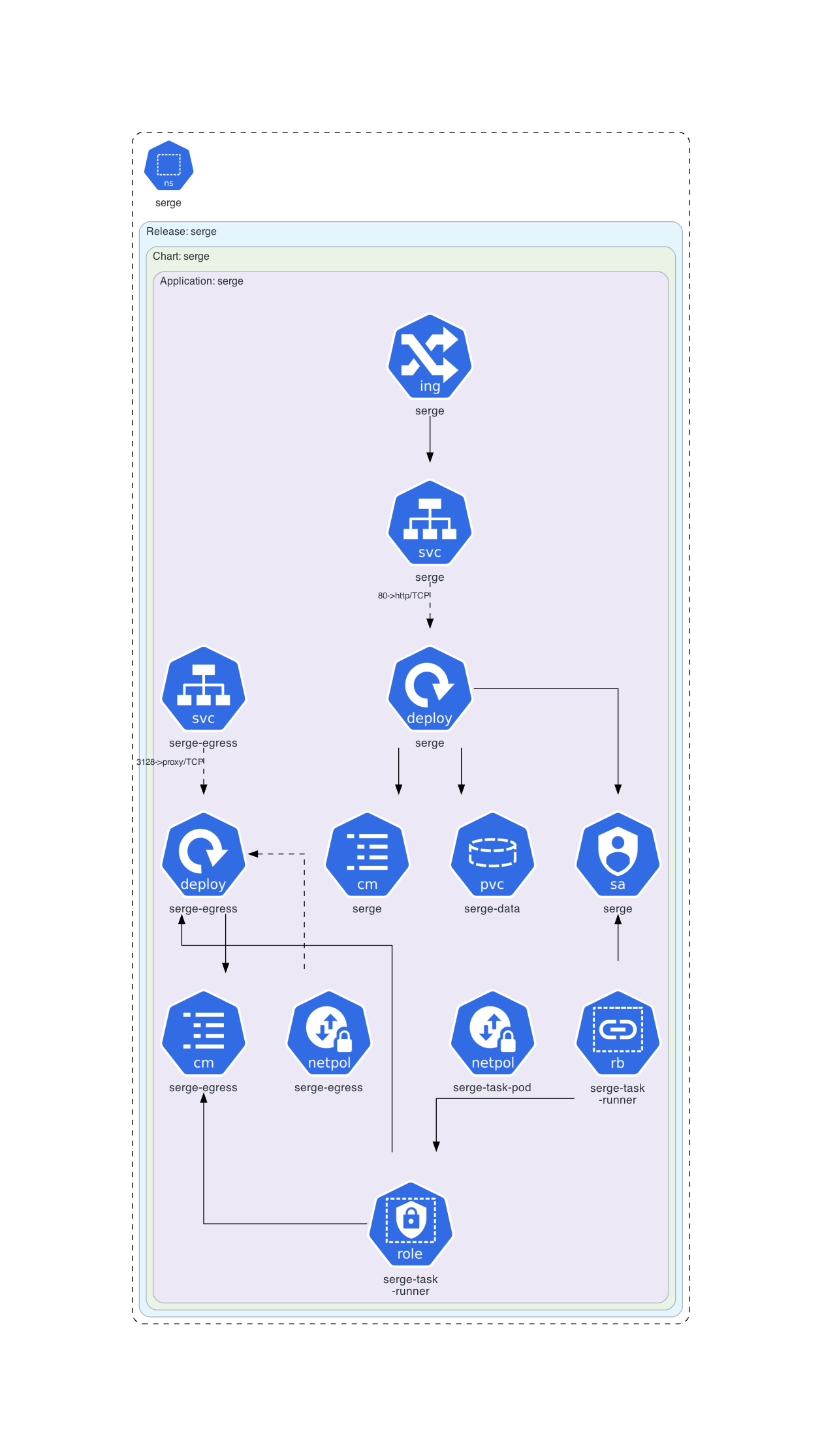
What the chart creates:
| Resource | Purpose |
|---|---|
Deployment serge (1 replica, Recreate) |
The orchestrator (reviewbot-web) |
Service serge + Ingress |
In-cluster + external access (ALB in prod) |
PVC serge-data + ConfigMap serge |
SQLite store + non-secret runtime env |
ServiceAccount + Role/RoleBinding serge-task-runner |
Lets serge create Jobs + per-job Secrets and read the egress Service |
Deployment/Service/ConfigMap serge-egress |
The allowlisting forward proxy for runner pods |
NetworkPolicy serge-egress |
Proxy may reach :443 + kube-dns only |
NetworkPolicy serge-task-pod |
Runner pods may reach only the proxy, kube-dns, and serge’s callback |
Runner pods themselves are not in the chart — serge creates them at runtime,
one per request, as batch/v1 Jobs.
- Backends:
taskExecution.kubernetes.enabled=trueturns on task pods;reviewPods=truealso runs reviews in pods. - Isolation: the ephemeral pod + the egress allowlist. Secrets never sit next to arbitrary fork code on the long-lived host.
- Good for: many repositories, heavier toolchains (the runner image carries the repo’s build/lint stack), and horizontal isolation per request.
See Deploying serge and
the production values tracked outside this repo, in
transformers-ci-playbooks as serge/env/prod.yaml (this repo carries only
deploy/helm/env/example.yaml).
Regenerating the diagram
The Kubernetes diagram is reproducible from the chart:
pip install KubeDiagrams        # provides `kube-diagrams`
brew install graphviz helm      # `dot` + `helm`

deploy/scripts/gen-arch-diagram.sh   # → docs/assets/architecture-k8s.png
The script runs helm template with the pod backend enabled and pipes the
manifests through kube-diagrams.
Data and persistence
| Data | Where | Notes |
|---|---|---|
| Jobs, drafts, provider configs, cached tokens | SQLite (WEB_STORE_PATH) |
Single writer → 1 replica; on a PVC/volume so it survives restarts |
| Clone cache | WEB_CLONE_CACHE_DIR |
Shallow bare-clone cache; point at durable storage in production |
| Runner pod checkout | pod emptyDir |
Self-contained standalone clone; evaporates with the pod |
| Secrets (App key, OAuth, LLM keys) | env / Kubernetes Secret | Never enter a sandbox or runner pod’s git remote |
Related pages
- How it works — the review lifecycle step by step.
- Tasks flow — the write-capable
POST /taskspath. - Configuration — every env var, including the backend and pod settings.
- Security / Security architecture — the trust model and the sandbox/egress boundaries.